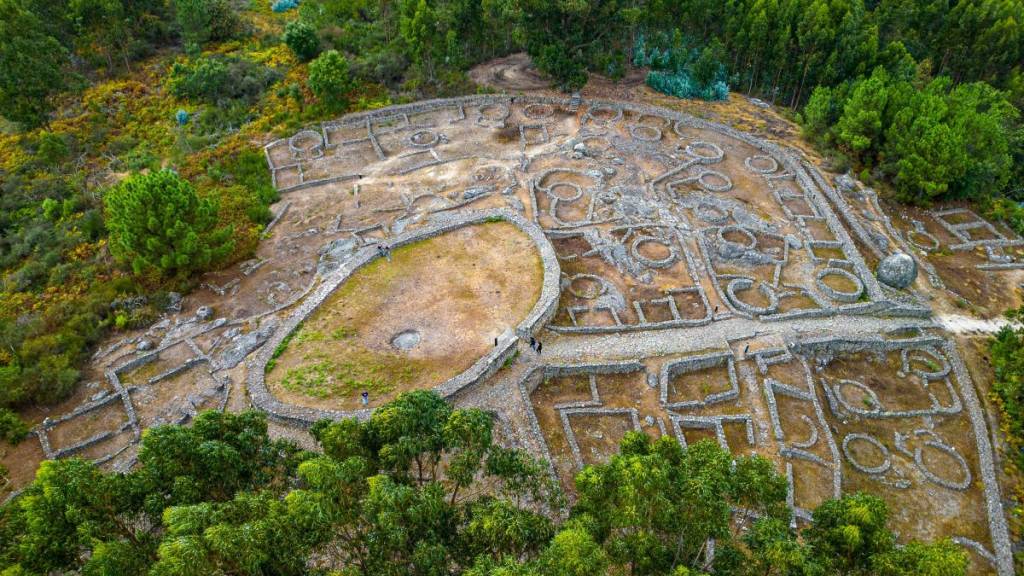

There is a nearly 2,000-year-old settlement hidden atop a hill near Porto —and, despite having already captured the attention of the international press, it remains completely unknown to most Portuguese people. The Monte Mozinho fortified settlement in Penafiel was recently described by the Spanish publication Viajar (part of the El Periódico group) as “a hidden treasure” and “Portugal’s Dead City,” while National Geographic España listed it among “one of the largest Roman hillforts on the Iberian Peninsula”—even going so far as to compare the texture of its ruins, set among heather, to “a miniature Machu Picchu transported to Europe.”
A city that remains a mystery
It was in 1919 that the scholar Francisco Soares de Lacerda Machado first climbed this hill, which rises to an altitude of more than 400 meters, and named the site “Cidade Morta”—a name that persists to this day.
According to “RTP Ensina, ” the first excavations at these ruins took place in the 1940s, but they were interrupted several times; work resumed in the 1970s, and more recent excavations have since been carried out. Since 1948, the Castro has been classified as a Site of Public Interest.
Two villages, one hill
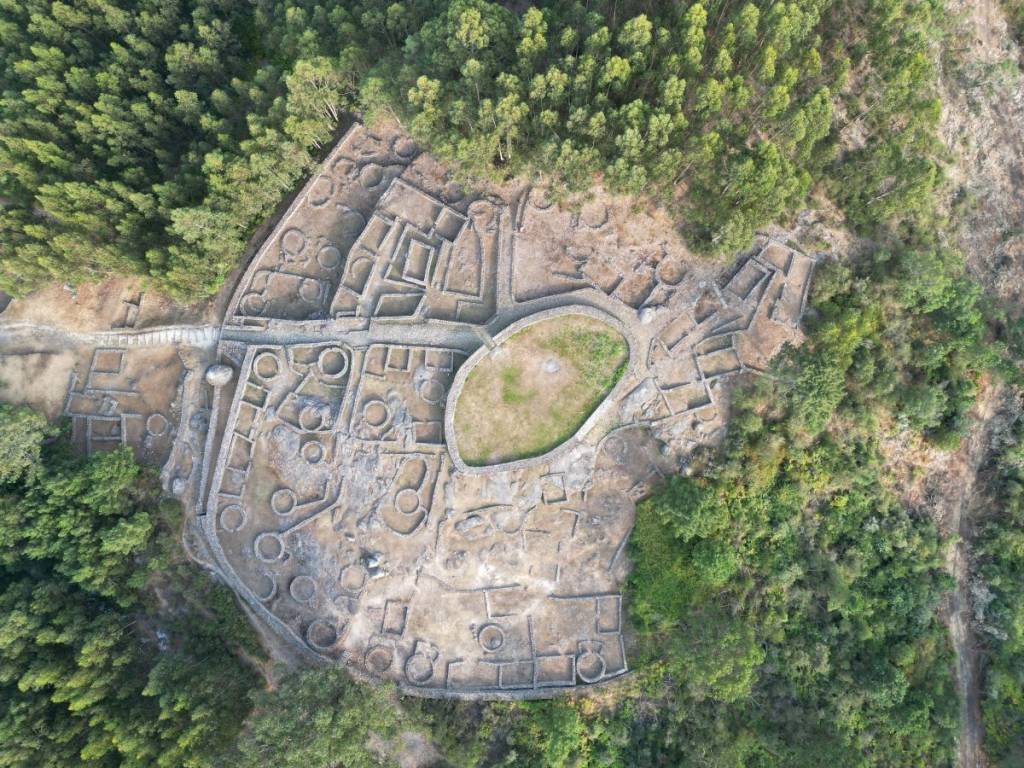
Covering approximately 20 to 22 hectares —the equivalent of several soccer fields —the settlement was founded between the late 1st century B.C. and the early 1st century A.D., during the integration of the northwestern Iberian Peninsula into the Roman world. What makes it unique is the blend of traditions evident in its architecture: houses with circular courtyards, typical of the Galician castro culture that already existed there, alongside typically Roman quadrangular structures—evidence of a coexistence between the two peoples that lasted several centuries.
Towers, stone warriors, and an empty acropolis
The fort’s defensive system included several lines of walls. At the entrance to the upper wall, two turrets flanked the access point. It was precisely there that archaeologists found two statues of Galician warriors, now on display at the Penafiel Municipal Museum.
At the highest point of the hill lies the acropolis, enclosed by a thick wall and with no structures inside—a space that likely served as a venue for games, assemblies, and a marketplace. From the top, the view stretches to the Serra do Marão to the east and the Serra de Montemuro to the south, with the Cavalum River valley marking the natural path to the Douro.
How to visit
For those who want to better understand what they are seeing, the Monte Mozinho Castro Interpretive Center, opened in 2004, features models and artifacts that complement a visit to the archaeological site. The Castro is also part of the Network of Castros of the Northwestern Peninsula and the Route of the Castros and Verracos, an itinerary that crosses the border between Portugal and Spain. Guided tours for groups can be booked through the Penafiel Municipal Museum.
Don’t miss out! Follow us on Facebook, Instagram, and now on WhatsApp too !