Porto is a city brimming with charm, but also with history and stunning buildings. Located in the heart of the Historic Center, a UNESCO World Heritage Site, the Palácio da Bolsa— or the Palace of the Porto Commercial Association— is one of Porto’s most iconic landmarks.
Like other local palatial-style buildings, it has never been associated with a throne or a king. What does this mean? Well, since the Middle Ages, Porto has always been a distinctly bourgeois city. Therefore, the palaces found here were neither official residences nor the homes of kings and queens.
In fact, the very origins of the Palácio da Bolsa, dating back to the 19th century, are linked to Porto’s bourgeois character. Even though it’s a city landmark, have you never been inside this national monument? Famous for its spectacular Arab Hall, believe me, there’s much more to see inside. So, “join us on this guided tour,” as the great Paula Moura Pinheiro would say!
Table Of Contents
 Photo courtesy of the Palácio da Bolsa / Publicity
How did it all begin?
With over a century of history, this is one of the national monuments that all residents and tourists should visit at least once in their lifetime. The building took more than 60 years to construct and has been home to the Porto Chamber of Commerce since its inception .
The Palace was built on the ruins of the former Convent of São Francisco, which burned to the ground during the Siege of Porto in 1832. It was precisely on the land that once belonged to the clergy that one of the symbols of local commercial activity was born.
 © @denisgiacobelis | Details of the Pátio das Nações.
The Donation by Queen Maria II
In 1834, Queen D. Maria II granted the lands of the former convent to the city’s business community, with the aim of establishing the Commercial Court and the Commercial Association (founded that same year).
A few years later, in 1842, the cornerstone was laid for the construction of the Palácio da Bolsa. However, as previously mentioned, the project took about seven decades to complete, involving various architects, plasterers, painters, masons, and hundreds of laborers. The result is a building that blends diverse styles, where each room has a story to tell.
A Visit to the Palácio da Bolsa
The nooks and crannies of this beautiful building are well worth a visit. There are many details to admire, but also plenty of interesting facts to discover. Without a doubt, the Arab Hall is one of its highlights, particularly because it transports us to another world without us even leaving our seats.
This will, of course, be one of the stops on our itinerary. However, there is much more to discover on this guided tour of the Palácio da Bolsa.
Pátio das Nações
The “Secret Porto” tour begins in the photogenic Courtyard of Nations. Looking around—even though we’re still at the very beginning of this experience—we’re immediately struck by the space’s rich ornamentation.
This is the gateway to the interior of the Porto Commercial Association Palace. Right away, there’s an interesting aspect worth noting. It is precisely here that the only remaining traces of the old Convent of São Francisco can be found . This means that the Pátio das Nações was built on the ruins of the old convent cloister, inheriting from that era the concept of an open space.
However, this is not the only noteworthy fact. In this atrium, you can see several coats of arms from different geographical locations—a scene that lives up to the name “Pátio das Nações.” These coats of arms represent, specifically, the 20 nations with which Portugal maintained the most active trade relations in the 19th century. Spain, France, and the United Kingdom are just a few of the countries represented there.
 © @denisgiacobelis | Ceiling of the Pátio das Nações.
Grand Staircase
Next, we head toward the monumental Grand Staircase. Along with the Arab Hall, this is one of the Palace’s most impressive spaces. But it is also one of the reasons why the project took so long to complete.
Here alone, it is estimated that it took about 40 years to finalize every detail of the staircase. Designed by architect Gustavo Adolfo Gonçalves e Sousa, there are several points of interest, most notably the meticulous decorative details.
This sumptuous staircase features two bronze chandeliers by Soares dos Reis, each weighing about one and a half metric tons.
Also by the same artist, two of the six busts that adorn the surroundings of the Grand Staircase are particularly noteworthy. In addition, we highlight other attractions:
- The impressive allegorical frescoes by António Ramalho;
- The presence of other busts, created by the master Teixeira Lopes.
 © @denisgiacobelis | Grand Staircase.
Audience Chamber (former Commercial Court)
When the land was donated, one of Queen Maria II’s prerequisites was the creation of the Commercial Court. Although it had no judicial power per se, commercial disputes in the city of Porto were to be resolved here.
With its furnishings virtually intact, it is clear that this room was never subjected to misuse. Even so, the Commercial Court remained active for several decades.
Like other areas of the Palácio da Bolsa, this space—also known as the Audience Chamber— features exquisite decoration, with its paintings being particularly noteworthy.
In addition, we had the opportunity to visit the “almost secret” Medina Room, where the jurors deliberated.
 © @denisgiacobelis | Former Commercial Court.
Arabic Hall
After visiting the former Commercial Court, we explored other equally interesting spaces, such as the General Assembly Hall and the Portrait Room. However, nothing compares to the sense of wonder we felt upon entering the Arab Hall.
Suddenly, we are transported to a place that doesn’t seem to be in Porto. As its name suggests, everything here evokes Muslim culture and architecture. This project, designed by Gustavo Adolfo Gonçalves e Sousa, is a true masterpiece.
 © @denisgiacobelis
For this building, the architect drew inspiration from one of Spain’s (and the world’s) most important wonders: the famous Alhambra Palace in Granada. For several centuries, this was the pinnacle of the Muslim presence on the Iberian Peninsula.
So it’s no wonder that the Alhambra is one of Adolfo Gonçalves e Sousa’s major sources of inspiration. In this room, more than in any other, the richness of the decorative details— in materials such as stucco, wood, and gold leaf— takes center stage .
Repeating Arabic inscriptions cover the walls. Here is an explanation of each one:
- The red one : “Glory to Allah”;
- In blue: “Allah protects Caliph Miriam II,” in honor of Queen Maria II;
- In green: “Allah above all.”
 © @denisgiacobelis
Everything in this space is “exotic.” In fact, the only elements that refer to the Portuguese identity of the place are two coats of arms: one for the city of Porto; the other featuring the national emblems, in honor of the House of Braganza (from the Liberal era). In addition, there’s another interesting detail.
If you look closely, you’ll notice that there is no symmetry between the main entrance door and the floor. Is this an architect’s mistake? Not at all! This “imperfection” was intentional, since in Islam only Allah is perfect. Thus, in keeping with Muslim architectural tradition, this was a “deliberate imperfection.”
Today, in addition to guided tours of the Palácio da Bolsa, the Arab Hall often hosts private events and/or classical music concerts, thanks to its excellent acoustics.
 © @denisgiacobelis
Candlelight Concerts at the Palácio da Bolsa
As you step through the doors of the Palácio da Bolsa, you’re greeted by an atmosphere of rare elegance. Under the soft glow of thousands of candles, the historic halls reveal their full grandeur, transforming into the perfect setting for an unforgettable musical journey. Amid timeless melodies and contemporary interpretations, each concert takes on a special dimension, while the gilded details, ornate ceilings, and flickering candlelight create an atmosphere straight out of a movie.
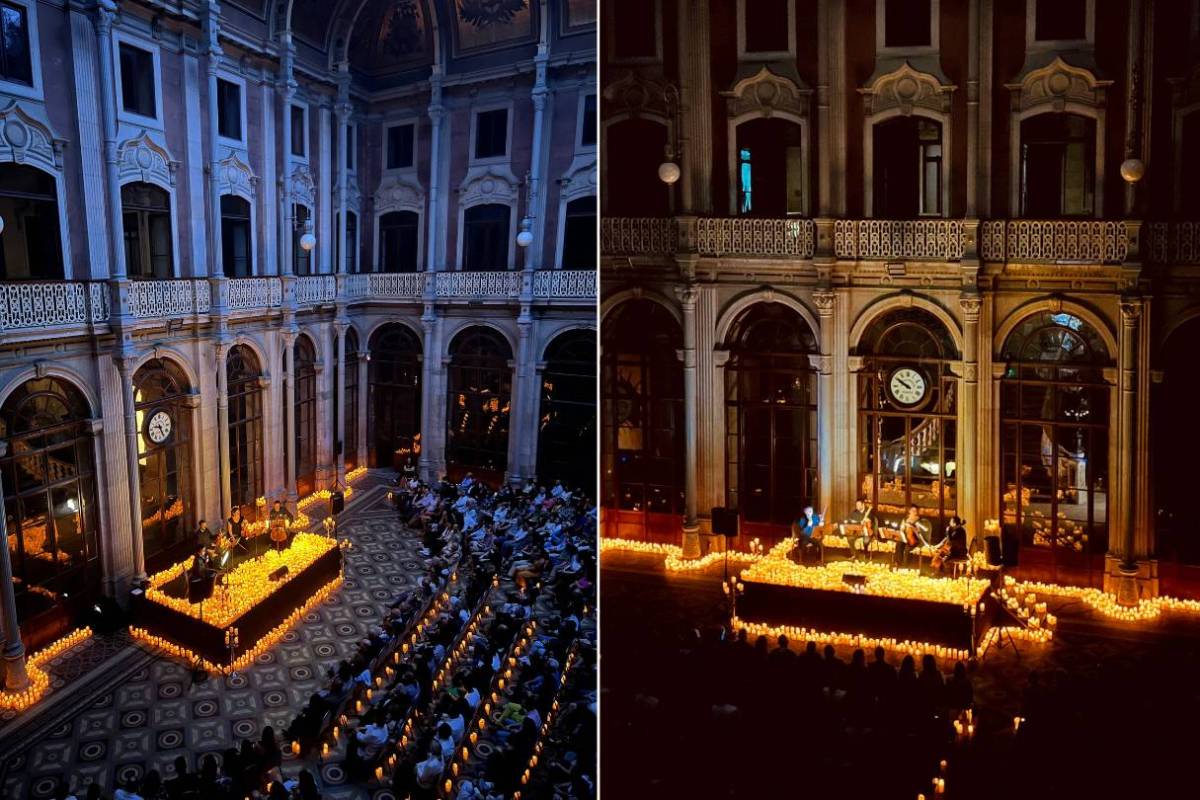 Candlelight Concerts at the Palácio da Bolsa
Other Interesting Facts
The beauty and history of the Palácio da Bolsa fascinate us. However, while it’s impossible to tell you everything, here are a few more interesting facts about this Porto landmark:
- Gustave Eiffel, designer of the world-famous Eiffel Tower (in Paris), had an office in this building between 1875 and 1877.
- The Arab Hall took 18 years to build;
- There are some rare and valuable objects, such as the gold pen that Queen Maria II used to sign the deed donating land from the former Convent of São Francisco for the construction of the Palácio da Bolsa.
Refinement, creativity, culture, art, and commerce—all these terms perfectly capture the essence of the Palácio da Bolsa, one of the most beautiful monuments in the city of Porto!
📍Where: Rua de Ferreira Borges, 4050-253 Porto
ℹ️More information: 22 339 9000