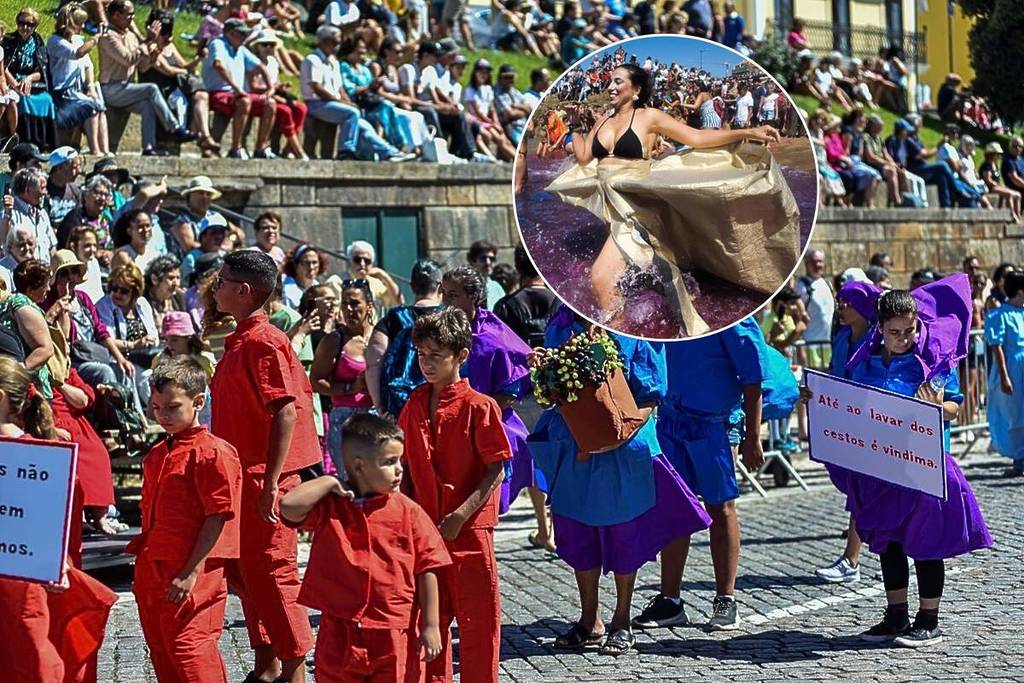

There’s no August in Porto without the traditional Cortejo do Traje do Papel, also known as the Cortejo de São Bartolomeu. With over 150 years of history, the iconic parade will once again take to the streets of the Foz neighborhood on Sunday, August 30. And this year, there’s an important milestone to celebrate.
According to the Union of Parishes of Aldoar, Foz do Douro, and Nevogilde (UFADN), as cited by the Porto City Council’s news portal, the 2026 edition will feature a “record number” of 700 extras. Held annually, the event usually brings together around 500 extras and attracts thousands of onlookers to Porto.
From the Procession to Intangible Cultural Heritage

Under the theme “Fables and Legends,” the centuries-old parade begins at 10:30 a.m. on Rua das Sobreiras, continuing along Passeio Alegre and Rua Senhora da Luz. The procession culminates at Praia do Ourigo, where one of its most eagerly awaited moments takes place: the traditional “holy bath” —the bath of Saint Bartholomew.
It is worth noting that it is not just the “record number” that makes this year’s event special, as the Cortejo do Traje do Papel has been included in the National Inventory of Intangible Cultural Heritage (INPCI) and is a candidate for recognition by UNESCO.
A journey back in time to “scare away the Devil”

To understand the context, we must go back to the 19th century and the centuries-old pilgrimage of São Bartolomeu. Popular legend from that time holds that, around this time of year, the Devil roamed freely through the streets. Salvation, however, lay in the waves: the people believed that the saint himself manifested in the waters of the sea, and so the devotees threw themselves into the surf during the famous “holy bath,” in an authentic ritual of protection and purification.
The magic and fragility of paper only became part of this tradition much later, in the 1930s. The irreverence was introduced by a man of the sea—the Costa Padeiro boatman—who at the time associated the event withthe picturesque“Festa do Banheiro.” However , the first official procession, with the paper costumes parading in all their glory to the cold waters of Foz, did not take to the streets until 1952.