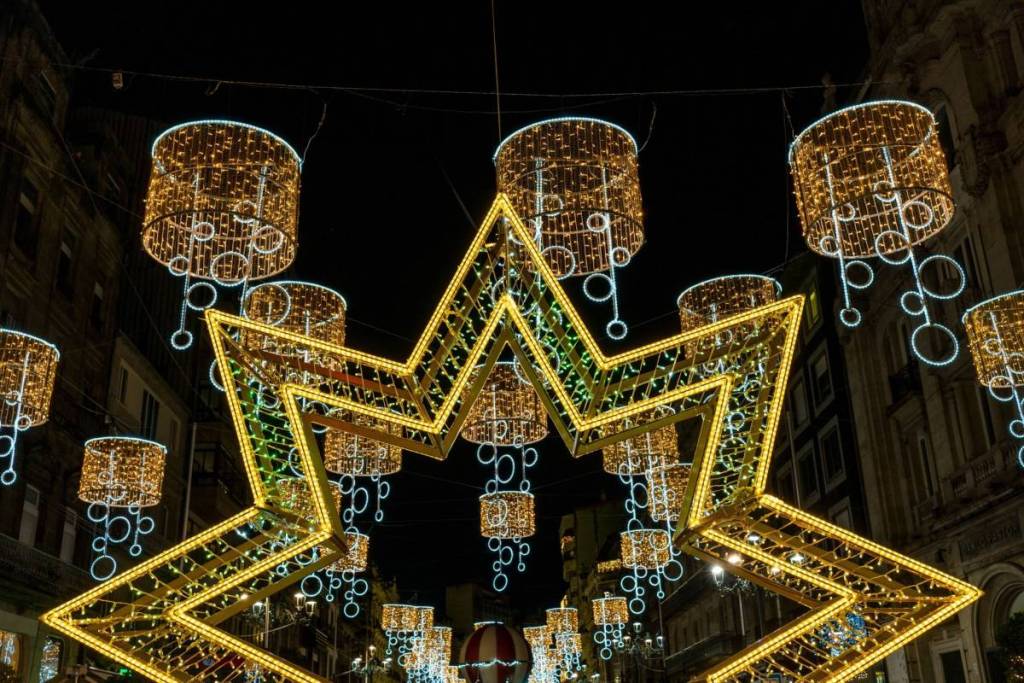

It’s already part of the tradition for many Portuguese people: in December, they hit the road to see the lights in Vigo. This year, the show begins on Saturday, November 14, at 8:00 p.m. (Spanish time), next to the giant tree at Porta do Sol. There are more than 12 million LED lights on some 500 streets, with 1,500 arches and 2,700 illuminated trees, according to O Atlântico.
What’s New This Christmas in Vigo
The big change this year is the location: the Christmas market (Cíes Market) and the Ferris wheel are moving from the Alameda to the area around the Vialia station. The Ferris wheel begins operating this Saturday at 8 p.m., and tickets cost 6 euros (4.20 euros for children under 6 and seniors over 65), according to El Español.

At the intersection of Gran Vía and Urzáiz Street stands an 18-meter-tall gift box adorned with 81,000 lights. Before the lights are turned on at 5:00 p.m., there will be a parade featuring Disney characters on García Barbón Street. The program also includes ice rinks (one of them in Samil), three tourist trains, a monumental nativity scene at the Casa das Artes, and a Christmas boat starting November 20.
What time do the lights come on?
Every day, starting at 6 p.m. in Spain (5 p.m. in Portugal). They turn off at 1 a.m. from Sunday through Wednesday and at 3 a.m. from Thursday through Saturday and on the eves of holidays. On the nights of December 23, 24, 25, 30, and 31, and January 1, 5, and 6, they stay on until morning. There’s no set end date yet, but they’re usually turned off in mid-January.

How to get from Porto to Vigo at Christmas
By car, it’s about 150 kilometers, and without traffic, the trip takes around an hour and a half: take the A3 to the border, and once in Spain, take the AP-9 and A-55 to the city center. In December, expect traffic jams on the roads leading into the city, especially on weekends.
By train, the Celta departs from Porto-Campanhã at 8:10 a.m. and 7:10 p.m. and arrives in Vigo-Guixar at 11:44 a.m. and 10:40 p.m. (Spanish time), according to the CP schedule. Please note: Until April 7, 2027, due to construction on the Spanish side, the section between Valença and Vigo will be served by bus, which does not carry wheelchairs or animals, explains RTP.
By bus, there are connections operated by ALSA and FlixBus, and the trip takes about two hours, according to Turismo de Vigo. Last year, Rede Expressos offered a same-day round-trip deal for 19.50 euros; it’s worth checking to see if they’re offering it again.
Plan everything in advance
Christmas in Vigo fills the city. During the long weekend in December, hotels are usually practically full, and traffic jams in the city center have made headlines in previous years. Here are a few tips:
- Book your hotel as soon as possible, especially for Saturdays and the holidays on December 1 and 8.
- If you can, go on a weekday: the lights are the same, and there are far fewer people.
- Buy your train and bus tickets early for the most popular dates.
- Remember that Spain is one hour ahead.
Don’t miss out! Follow us on Facebook, Instagram, and now on WhatsApp too!