On August 12, 2026, Portugal will host its first total solar eclipse on national territory since 1912. In Porto, the phenomenon will be visible as a very deep partial eclipse, with about 98% of the Sun’s disk covered by the Moon, in the late afternoon. The next total eclipse visible in Portugal is not expected until 2144.
What, exactly, is a total solar eclipse?
A solar eclipse occurs when the Moon comes between the Sun and Earth, casting its shadow onto the Earth’s surface and blocking sunlight in a specific region. When this alignment is perfect and the Moon completely covers the Sun’s disk, a total eclipse occurs. In this case, and only in this case, it is possible to observe with the naked eye phenomena such as the “Diamond Ring,” “Baily’s Beads,” and the solar corona—the Sun’s outer atmosphere, which is normally invisible.
Bragança, just a few hours from Porto, will see day turn into night

In Portugal, totality will occur only in a very narrow strip of the Montesinho Natural Park, in the district of Bragança—more precisely along the N308 road, between the villages of Rio de Onor and Guadramil. It will last only about 25 to 26 seconds.
The distance between Porto and Bragança is about 210 km, a drive of roughly 2 hours and 15 minutes to 2 hours and 30 minutes—close enough for a day trip from Porto. It’s worth noting that access to the exact viewing area for totality is restricted and controlled by Ciência Viva, with advance registration required through the 2026 National Eclipse Program.
What will be visible in Porto
According to calculations by astronomer Rui Jorge Agostinho, a researcher at the Institute of Astrophysics and Space Sciences, as cited by the Lusa news agency, Porto will experience a coverage of about 98.2%, one of the highest percentages in the country outside the path of totality, followed by Lisbon (94.5%) and Faro (92.7%).
The eclipse is expected to follow, approximately, this timeframe: beginning around 6:30–6:40 p.m., maximum around 7:30–7:40 p.m., and ending around 8:20–8:30 p.m., coinciding with late afternoon and with the Sun already very low on the horizon. Even though it will not reach totality, the decrease in brightness in Porto should be quite noticeable and may even cause a temporary drop in temperature.
How to View It Safely
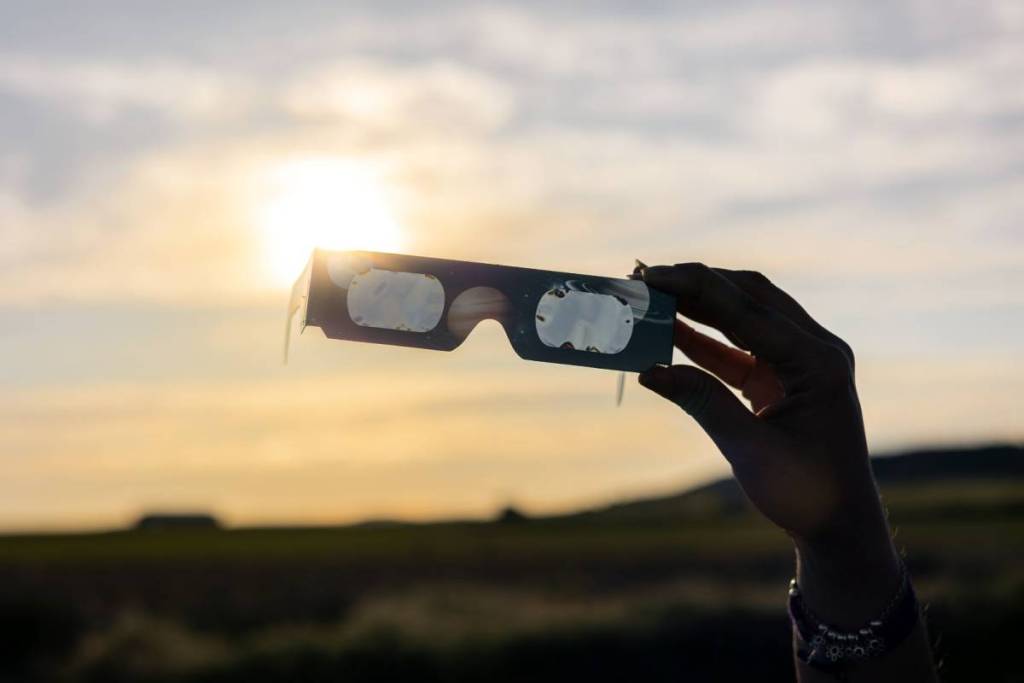
You should never look directly at the Sun, even during a deep eclipse —neither with the naked eye, nor with ordinary sunglasses, nor through binoculars or telescopes without a proper solar filter. It is essential to use eclipse glasses certified to the ISO 12312-2standard. The Directorate-General for Health and NASA emphasize this precaution, even when more than 90% of the Sun’s disk is covered.
Where to get eclipse glasses and what activities are happening in Porto
ZEISS, in partnership with the Club da Visão network (more than 600 optical stores nationwide), will distribute free eclipse glasses upon prior registration and while supplies last. In Porto, the Porto Planetarium – Centro Ciência Viva has been preparing for the event, with sessions dedicated to observing and exploring the phenomenon. Thus, the planetarium is also part of the network of institutions—along with the Institute of Astrophysics and Space Sciences and the Portuguese Astronomical Society—that will be monitoring the observation of totality in Bragança.
The complete list of activities by district, including Porto, can be found on the official website eclipse2026.pt, which also features a tool to check the exact percentage and times of the eclipse by municipality.
Don’t miss out! Follow usonFacebook,Instagram,andnowonWhatsApp too!