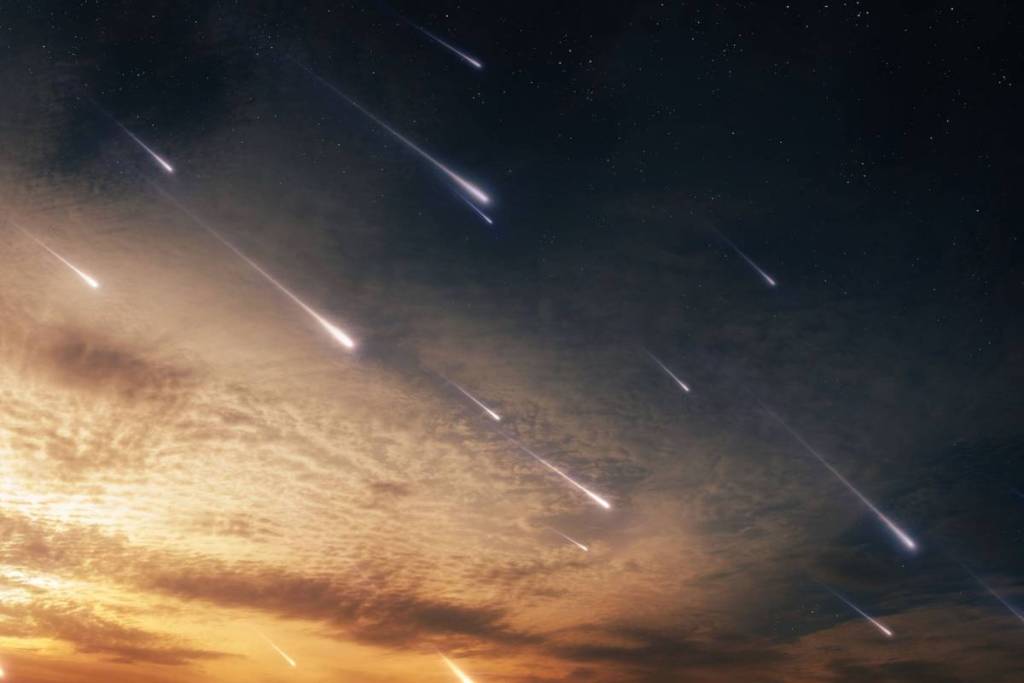

After the modest Draconids, fall has one of its most fascinating astronomical events in store for us: the Orionid meteor shower. Active through November 7, it is expected to peak on the night of October 21–22. Under a dark sky and under ideal conditions, up to 20 shooting stars per hour may be visible.
What makes the Orionids so special?

Considered one of the major annual meteor showers, the true magic of the Orionids lies in their origin. According to a recent article by BBC Weather, these meteors are fragments left behind by Halley’s Comet, one of the most famous comets in our Solar System—which completes one orbit around the Sun every 76 years (its next return is not expected until 2061).
The Orionids also stand out for their speed, as the particles that give rise to them enter Earth’s atmosphere at about 66 kilometers per second, leaving luminous trails that tear through the darkness.
Where (and how) to watch?
The golden rule is to avoid light pollution, so downtown Porto is not, in theory, the ideal spot. In these cases, it’s best to choose dark locations away from artificial lighting. However, if you don’t want to leave Porto, you can try the Foz waterfront or the Castelo do Queijo area, looking for a spot with a wide view of the sky and away from direct lights. Urban lighting will still limit your viewing, though.
On the outskirts of Porto, the Santa Justa and Pias mountain ranges in Valongo are also good options, as long as you choose an open, dimly lit area that’s accessible at night.
Whatever your destination—mountain or sea—make sure the weather conditions are favorable for observing the Orionids. Being by the sea doesn’t guarantee less light pollution: it’s important to choose a location away from artificial lighting.
This year, focus on the hours before dawn, after the Moon has set. Once you’re at your chosen spot, follow these tips:
- Give your eyes about 20 minutes to adjust to the lack of light.
- Forget binoculars or telescopes—the naked eye is the best way to catch the fast-moving meteors.
- Don’t just stare at one spot; let your gaze wander across the expanse of the sky.
- Try turning your back to the Moon to prevent its brightness from obscuring the fainter meteors.
Don’t miss out! Follow us on Facebook, Instagram, and now on WhatsApp too!