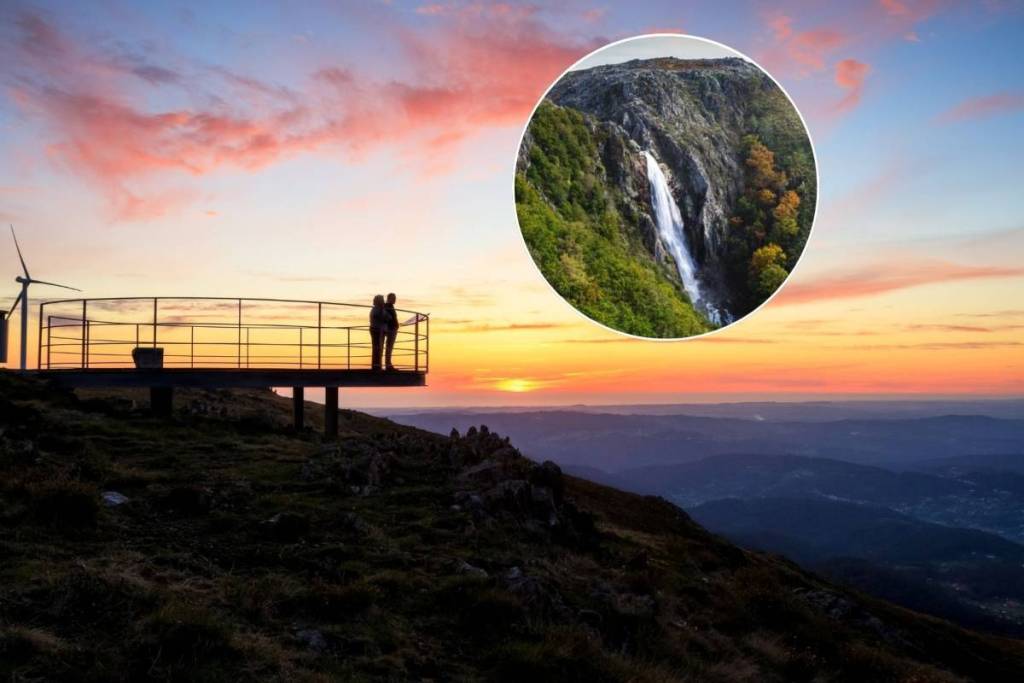

About an hour from Porto lies a 328-km² area recognized by UNESCO as a Global Geopark, where a waterfall over 70 meters high plunges among granite rocks, stones “give birth” to other stones, and a suspension bridge spans one of Europe’s wildest gorges. This is the Arouca Geopark.
What is the Arouca Geopark?
The Arouca Geopark corresponds exactly to the boundaries of the municipality of Arouca, in the district of Aveiro, and has been a UNESCO Global Geopark since 2009 —the second to be recognized in Portugal.
Across its 328 km², 41 geosites have been inventoried, documenting hundreds of millions of years of geological history—from schists over 500 million years old to fossils of giant trilobites, including the granites that form the Pedras Parideiras. Four of these sites are even recognized as being of international importance.
Frecha da Mizarela: one of Portugal’s tallest waterfalls

Standing over 70 meters high, the Frecha da Mizarela is the point where the Caima River cuts through granite rocks, a spectacular sight that can be admired from the Frecha da Mizarela Viewpoint, about 1 km before the Albergaria da Serra River Beach.
The waterfall’s origin is linked to differential erosion between granite and schist (a softer rock that yielded to the force of the water) and to the fault system that runs through the entire Serra da Freita. Surrounding it, the mountain range’s primitive vegetation still thrives—rhododendron, Alvarinho oak, and black oak—and the area serves as a refuge for birds such as the booted eagle.
Pedras Parideiras: the rocks that “give birth” to other rocks

In the village of Castanheira, also in the Serra da Freita, lies one of the world’s rarest geological phenomena: the “Castanheira nodular granite, ” estimated to be between 320 and 310 million years old. The alternating effects of winter cold and summer heat cause small mineral nodules to break away from the parent rock; as they fall, they leave behind perfect cavities—creating the illusion that the rock has given birth to another rock.
The phenomenon was already described in the 18th century and gave rise to folk legends of fertility, although today it is forbidden to remove any stones from the site. To understand the science behind the phenomenon, it’s worth visiting the Casa das Pedras Parideiras – Interpretation Center, open since 2012, which features an outdoor exhibition and a 3D film on the subject.
The Trails: Paiva Boardwalks and Bridge 516

If there’s one thing you can’t miss on a visit to the Arouca Geopark, it’s the Paiva Boardwalks: an 8,700-meter-long wooden structure built along the left bank of the Paiva River—one of Europe’s wildest rivers—that connects five different geosites along the way, amid waterfalls and rapids.
At one end of the walkways lies the Ponte 516 Arouca, 516 meters long and 175 meters high above the Paiva River. When it opened in May 2021, it was heralded as the world’s largest suspended pedestrian bridge; today, it ranks among the longest of its kind in existence.
The crossing, supported by just two main cables, offers views of the Paiva Gorge and the Aguieiras Waterfall—and is not recommended for those who suffer from vertigo. The bridge ticket also includes a visit to the boardwalks, provided it is done on the same day.
Giant trilobites: the Trilobite Museum
For those interested in paleontology, the Canelas Geological Interpretation Center, also known as the Trilobite Museum, houses one of the world’s most important fossil collections. Here, specimens of giant trilobites dating back some 465 million years have been found—among the largest ever recorded on the planet, with one specimen reaching 90 centimeters in length.
In 2022, the geosite was recognized by the International Union of Geological Sciences as one of the 100 most important sites in the world for its scientific significance.
Where to eat?
Arouca’s cuisine revolves around meat from the Arouquesa cattle breed, raised outdoors on the slopes of the Gralheira Massif without the use of feed. The most iconic dish is the Posta Arouquesa, veal slowly grilled over hot coals and seasoned only with salt, but there is also the Bife à Alvarenga, roast kid, and Portuguese-style stew.
For dessert, Arouca’s convent-style sweets include sweet chestnuts, “barrigas de freira” (nun’s bellies), “roscas” (ring-shaped pastries), and almond “charutos” (cigars)—and even a sweet named, precisely, “pedras parideiras” (birthing stones). Among the local highlights are Restaurante Alto-da-Estrada, located at the entrance to the town of Arouca since 1981, and Casa dos Bifes Caetano, on the banks of the Paiva River in Alvarenga, which has been serving the region since 1954.
How to get there from Porto
By car, the trip takes about an hour: the most direct route is to take the A32 toward Vale de Cambra/Arouca, then follow the national and municipal roads to the Serra da Freita, with mountain scenery to enjoy on the final stretch. There is no public transportation that serves the area well, so a car is really the best option.
Don’t miss out! Follow us onFacebook, Instagram , and now on WhatsApp too !