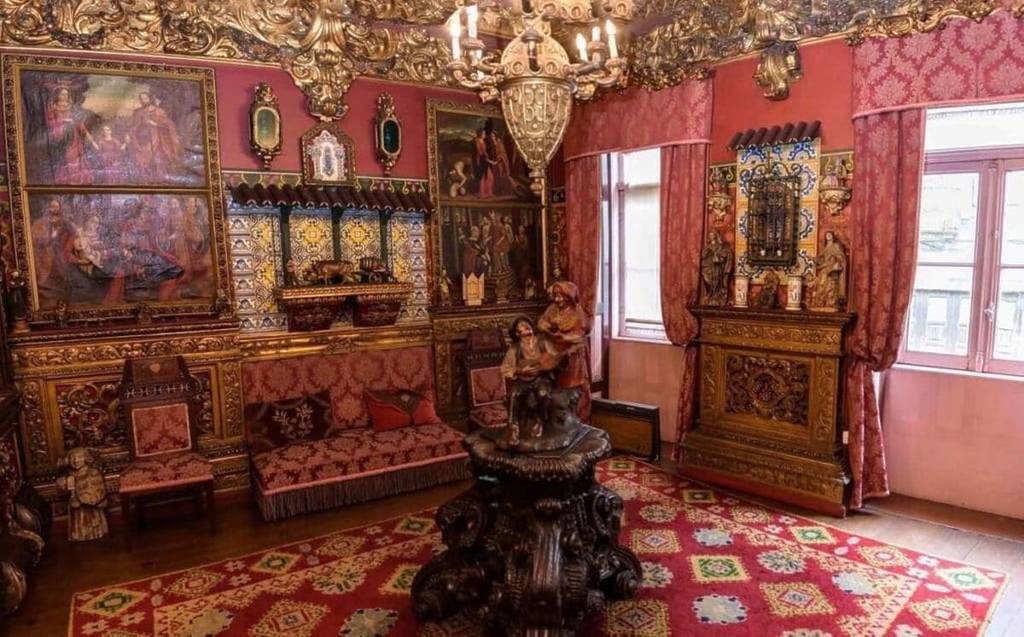
Does the Fernando de Castro House-Museum mean anything to you? If the name doesn’t ring a bell, then prepare to be amazed. This is an eccentric space, to say the least, with a lot to tell.
Located in Rua Costa Cabral, the number 716 doesn’t reveal the contents of its interior. Disguised by the simplicity of the building’s façade, the Casa-Museu Fernando de Castro hides a ‘treasure’. A veritable altar without a cult, but we’ll explain why later.
Paintings, sculptures, books and (lots of) gilded wood adorn the interior of the space, which has a collection of hundreds of pieces. A place that defies the logic inherent in any museum. But this is no ordinary museum. It is a house-museum and, as its name suggests, it reflects the personality of Fernando de Castro, its former owner.
Table Of Contents
Who was Fernando de Castro?
Before we tell you about our experience there, it’s important to get to know the mentor of this exuberant museum. Fernando de Castro (1889-1946) was the son of a prosperous merchant whose business was based in Rua das Flores in Porto.
When his father died in 1918, Fernando de Castro ensured the continuity of the business. However, the commercial world was not his great passion. In fact, the pulse of his life remained on the margins of his professional performance. Painter, poet, caricaturist and collector, the owner of number 716 Rua Costa Cabral was all this and more.
An art aficionado, Fernando de Castro turned his own home into a museum. Thanks to Maria da Luz Castro, his sister, who donated the space, today we have the doors open to this place full of stories to tell. The Soares dos Reis National Museum is currently in charge of the Fernando de Castro House-Museum. We had been wanting to visit this place for some time. That’s why we booked a guided tour that we’ll never forget.

A guided tour of an altar without a cult
Ana Anjos Mantua, coordinator of the Casa-Museu de Castro, welcomed Porto Secreto and accompanied us on a guided tour of the building’s various rooms. An essential aid to better understanding the apparent lack of logic.
Minhota Room (or Regional Room)
The tour begins in the old living room of the house and we are immediately surprised. You can see objects and pieces of art everywhere. A real ‘mess’, but captivating at the same time.
The Minhota Room is one of the few rooms where you’ll find popular figures. In fact, here you’ll find various elements alluding to Minho (and beyond), hence the name itself.
There are two types of collecting at the Casa-Museu Fernando de Castro. On the one hand, we have Sacred Art, which is present in practically the entire house. On the other hand, we have Portuguese Naturalist Painting,” explains Ana Anjos Mantua, the museum’s coordinator.

Dining Room
After passing through the vestibule, we find the Dining Room. Immediately, we are invaded by a feeling of ‘heaviness’. In other words, there’s a kind of horror of emptiness, but not only in this room. In fact, it’s a constant in the house.
Here we see covered walls, as well as a proliferation of religious images in a row, of all shapes and sizes. Religious figures are even a dominant factor almost everywhere.

Yellow Room
After climbing the first set of stairs, we enter the Yellow Room, where we are treated to a completely different atmosphere. Suddenly, it’s as if we’re in front of a ‘little Versailles’.
Golden tones and refinement dominate the decorative elements, instead of the typically religious features of the previous rooms. Ana Anjos Mantua, coordinator of the House-Museum, explains that this was a Ball Room.
Therefore, a space intended for moments of relaxation and fun. There’s even a slight ‘lightness’ in the air; you can breathe more here. By now, we’re sure that although this isn’t one of the most ‘obvious’ museums to visit in Porto, it really is worth it.

Access to the 2nd floor
In the gallery on the 2nd floor, and as you climb each step, it seems that you are immediately transported to a church. Again, religious images and reliquaries predominate.
There is also a stained glass window, whose bright colors and adornments make you feel like you’re in a cathedral. In fact, we need to explain the origin of this ‘absurd’ amount of sacred art.

Sacred Art in vogue
With the extinction of the religious orders in Portugal in the 18th century, some materials from churches, monasteries or convents were dismantled and sold.
In this context, some people, like Ferdinand II, bought a convent to convert it into a palace. But some, like Fernando de Castro, transported the religious temples directly to their homes.
This house is a true altar without worship,” says Ana Anjos Mantua, coordinator of the Casa-Museu de Castro.

Blue Room
The name of this room is due to the blue walls and curtains, but we could also call it the ‘Chinese Room’. After all, there are various oriental objects on display, such as Chinese figures, vases and fans, among others.

Caricature Room
In this room we come into close contact with the caricaturist side of Fernando de Castro:
Here we have two different themes. On the one hand, there are caricatures that are a humorous approach to the toponymy of various places. On the other hand, there are caricatures of members of Porto’s cultural elite [from the first half of the 20th century],” explains Ana Anjos Mantua, coordinator of Casa-Museu de Castro.


Bedroom
We’re almost at the end of the guided tour, absolutely enraptured by the experience. But just when you think nothing else can surprise you, you are greeted by the bedroom.
There is a mixture of sacred art and refinement, and on the bed there are some religious images that face us head-on. The definitive refuge of a peculiar and eccentric man; a figure devoted to art and with strong beliefs.

For all this (and much more), it’s worth visiting this ‘secret’ museum in Porto; an ultimate altar without worship!
How to visit this place?
To visit the surprising Casa-Museu Fernando de Castro, located at Rua de Costa Cabral 716, you need to book in advance using this online form.
The guided tour lasts one hour and costs €5 (Portuguese citizens and/or residents in Portugal can take advantage of Voucher 52).
It should be noted that this cultural experience is aimed at people over 8 years old and that backpacks, bags and large purses are prohibited.
Contacts: 22 339 3770 / Instagram profile